The AI Diagnostic Recommendation Engine
Of the three options our team evaluated, one compounds in value with every exam, leverages equipment the clinic already owns, and builds a data advantage that is difficult for online retailers or corporate chains to replicate. That is the one we are proposing.
Three Options We Evaluated
Before settling on the AI engine, the team pressure-tested two other revenue-defense strategies. Each is real, but only one is durable as a lead initiative.
1. AI Diagnostic Recommendation Engine — Selected
A proprietary engine integrated with the practice management system that prompts diagnostic recommendations based on patient profile, age, breed, history, and AAHA-aligned guidelines. Builds a compounding data advantage with every visit.
2. Clinic-Branded Online Pharmacy
Launch an e-commerce storefront (via a partner such as Vetsource) to recapture product revenue through home delivery and autoship. Addresses the online-pharmacy migration directly but competes head-on with capitalized retailers on their home turf.
3. Preventive Care Membership Plans
Subscription wellness packages bundling annual bloodwork, vaccinations, and dental care. Locks in recurring revenue and increases visit frequency. We are proposing elements of this as a complement to the AI engine, not an alternative.
Why We Selected Option 1
The AI engine wins on three fronts the other options cannot match simultaneously:
- It defends the exam room, which is the part of the revenue stack online competitors cannot touch.
- It monetizes assets the clinic already owns — analyzers, imaging units, staff expertise — rather than requiring a new revenue channel.
- It compounds. Every visit feeds the model; every recommendation improves the next one. This is a moat that accumulates, not a campaign that decays.
We are layering membership-plan elements on top as a complementary revenue stream. Together, they create a visit-driven flywheel: the AI engine raises revenue per visit; the memberships raise visit frequency.
How It Works in the Exam Room
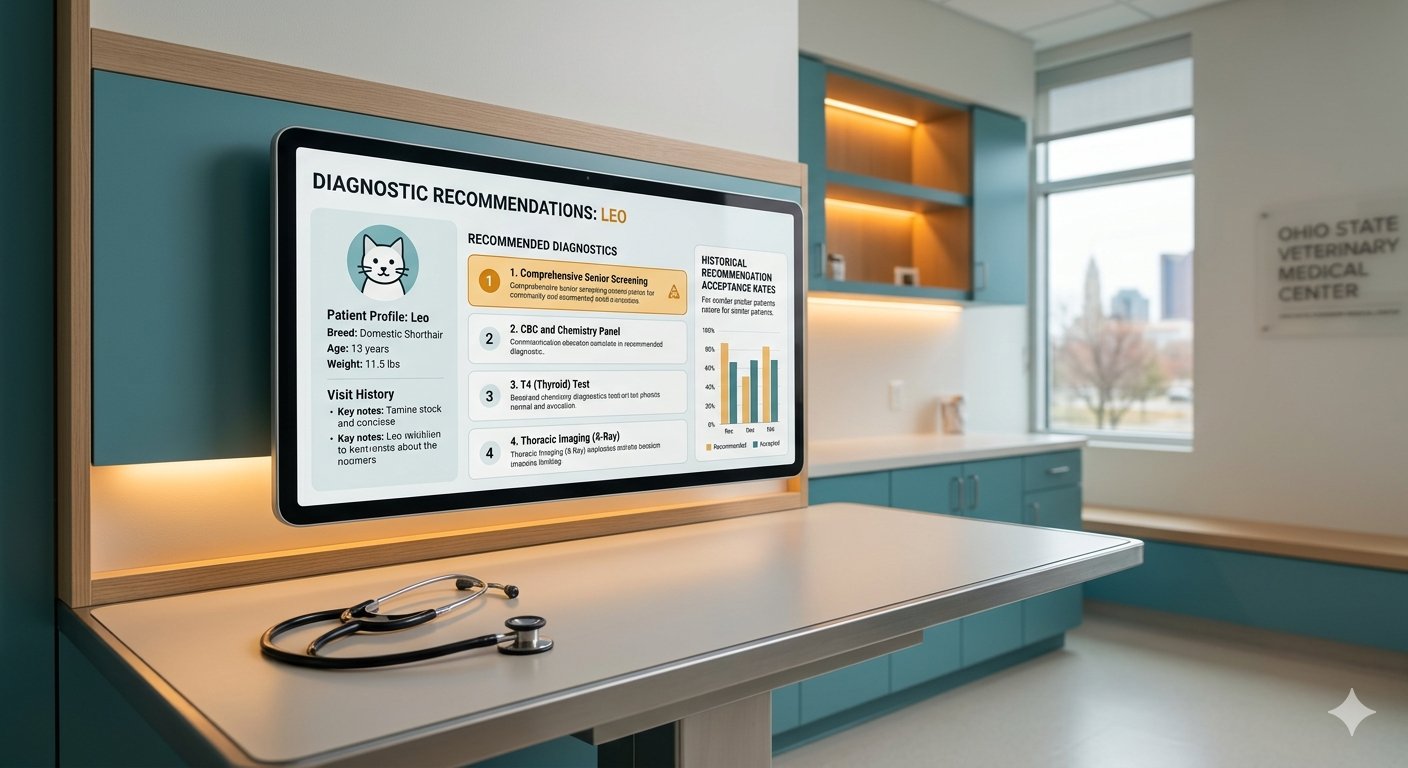
A client arrives for a routine visit. The PMS pulls patient history, age, breed, and prior diagnostics. The AI engine compares that profile to AAHA-aligned guidelines and surfaces a ranked list of recommended diagnostics — bloodwork, imaging, or screening tests — directly inside the clinician's workflow.
The clinician retains full authority. The engine never auto-orders; it recommends and flags. Over time, the engine learns which recommendations the clinic's own doctors accept and which they pass on, and the quality of its prompts improves.
Expected ROI
Why this is defensible: Bloodwork, urinalysis, and radiographs require trained hands and licensed veterinary interpretation. No e-commerce platform can replicate what happens in the exam room.
Estimated Costs by Department
The cost model below reflects the CEO deck's department-by-department breakdown. Year 1 is build-heavy; Year 2 is run-rate.
Year 1 — Build & Launch
- IT — PMS integration build, model hosting, security review
- Change Management — Staff workflow redesign and adoption coaching
- Marketing — Client-facing communications about enhanced screening program
- HR — Training hours, role definition updates
- Finance — Reporting build, KPI instrumentation
Year 1 total: ~$76K
Year 2 — Run Rate
- IT — Hosting, model retraining, maintenance
- Change Management — Continuous improvement loops
- Marketing — Ongoing senior-care and membership outreach
- HR — New-hire onboarding for the workflow
- Finance — Quarterly KPI reviews
Year 2 total: ~$46K
12-Month Rollout, Two Board Checkpoints
The rollout runs four phases from data foundation to clinic-wide deployment, with named owners per milestone. Two milestones are GO / NO-GO board gates — a KPI dashboard activation at Month 8 and a first ROI review at Month 11.
Phase 1 — Foundation Months 1–4
M1 · Vendor & EHR integration selection
IT / OpsM2 · Historical patient data audit
IT / FinanceM3 · AI model initial training on clinic data
IT / Clinical
Phase 2 — Pilot Months 5–7
M4 · Soft launch with 2 selected vets
Ops / HRM5 · Staff training & change management
HRM6 · Client transparency rollout
Marketing
Phase 3 — Deployment Months 7–8
M7 · Clinic-wide deployment & full EHR integration
IT / Ops★ M8 · KPI dashboard & baseline reporting
Finance / Ops · Board checkpoint
Phase 4 — Optimization Months 9–12
M9 · Acceptance / decline feedback loop
IT / ClinicalM10 · Legal & data governance audit
Finance / Legal★ M11 · First ROI review & board report
Finance / CEO · Board checkpoint
★ The two board checkpoints: Month 8 activates the KPI dashboard with baseline metrics. Month 11 delivers the first ROI review. Both are GO / NO-GO gates — if the capture metrics don't hold, the board can pause further spend before Phase 4 optimization costs are committed.
Project Resources Needed
People
Project sponsor (clinic owner), IT lead, clinical champion, change-management coach, marketing partner, finance reviewer.
Tools
PMS integration surface, analytics environment for the recommendation model, KPI dashboarding, and a project-management tracker (e.g. Google Sheets Gantt).
Budget
~$76K Year 1 / ~$46K Year 2 across IT, change management, marketing, HR, and finance, with a ~21-month payback window against recaptured revenue.
Ready for the Next Step
The call to action from the Week 5 deck: approve the discovery and pilot phases (Milestones 1–4), so the clinic can validate the recommendation uplift against its own data before committing to the full rollout.
Meet the Team Behind the Proposal